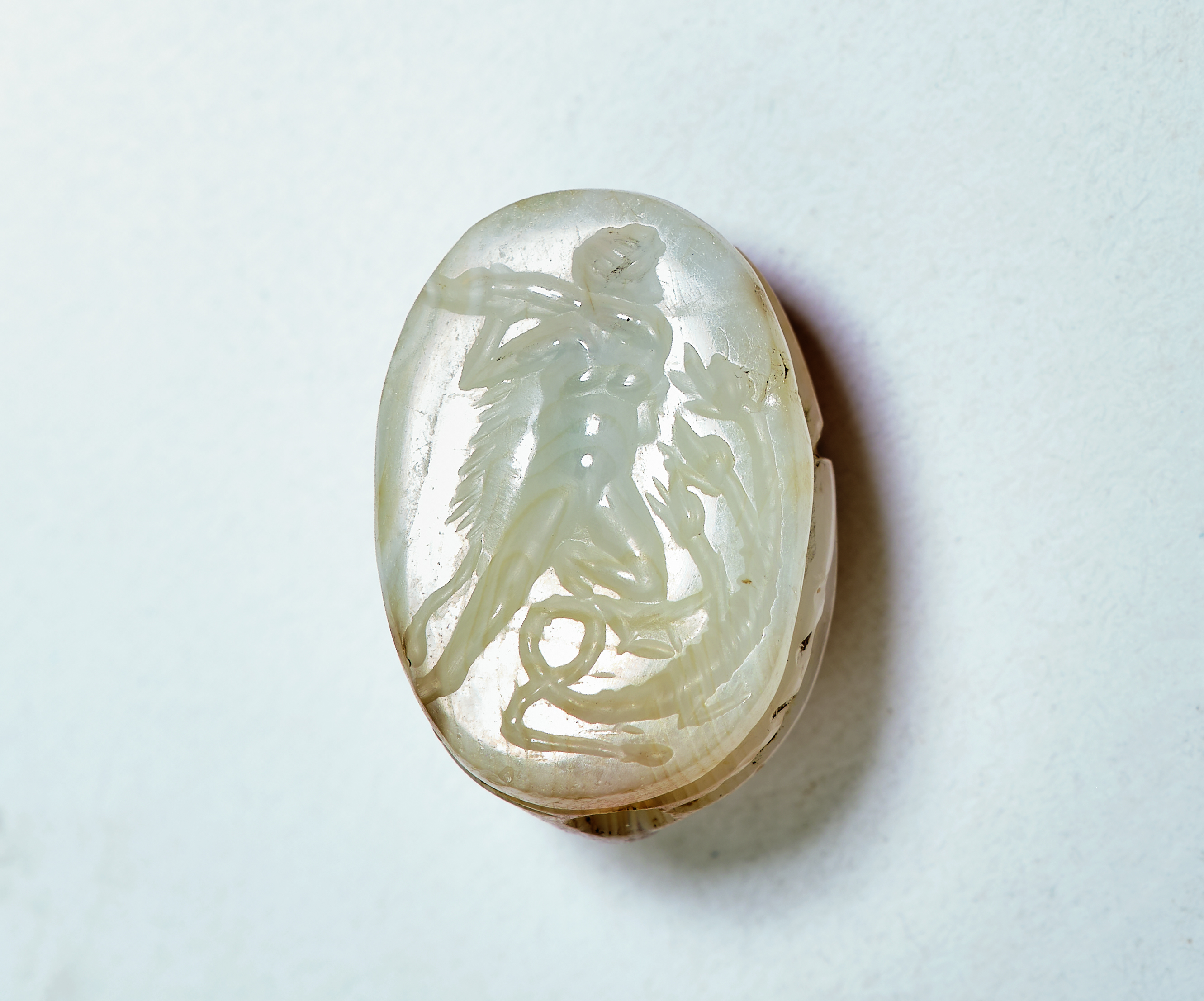
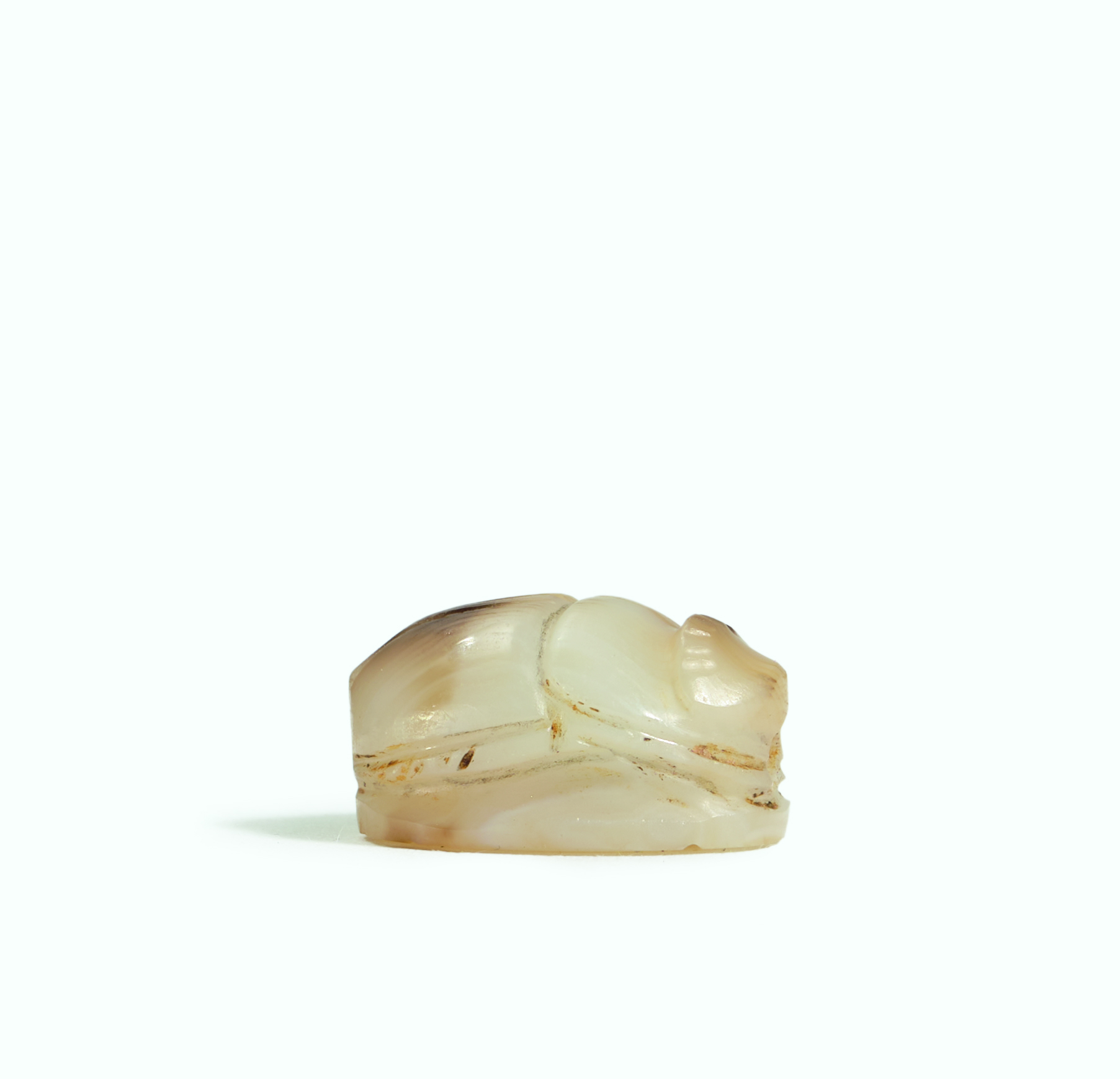
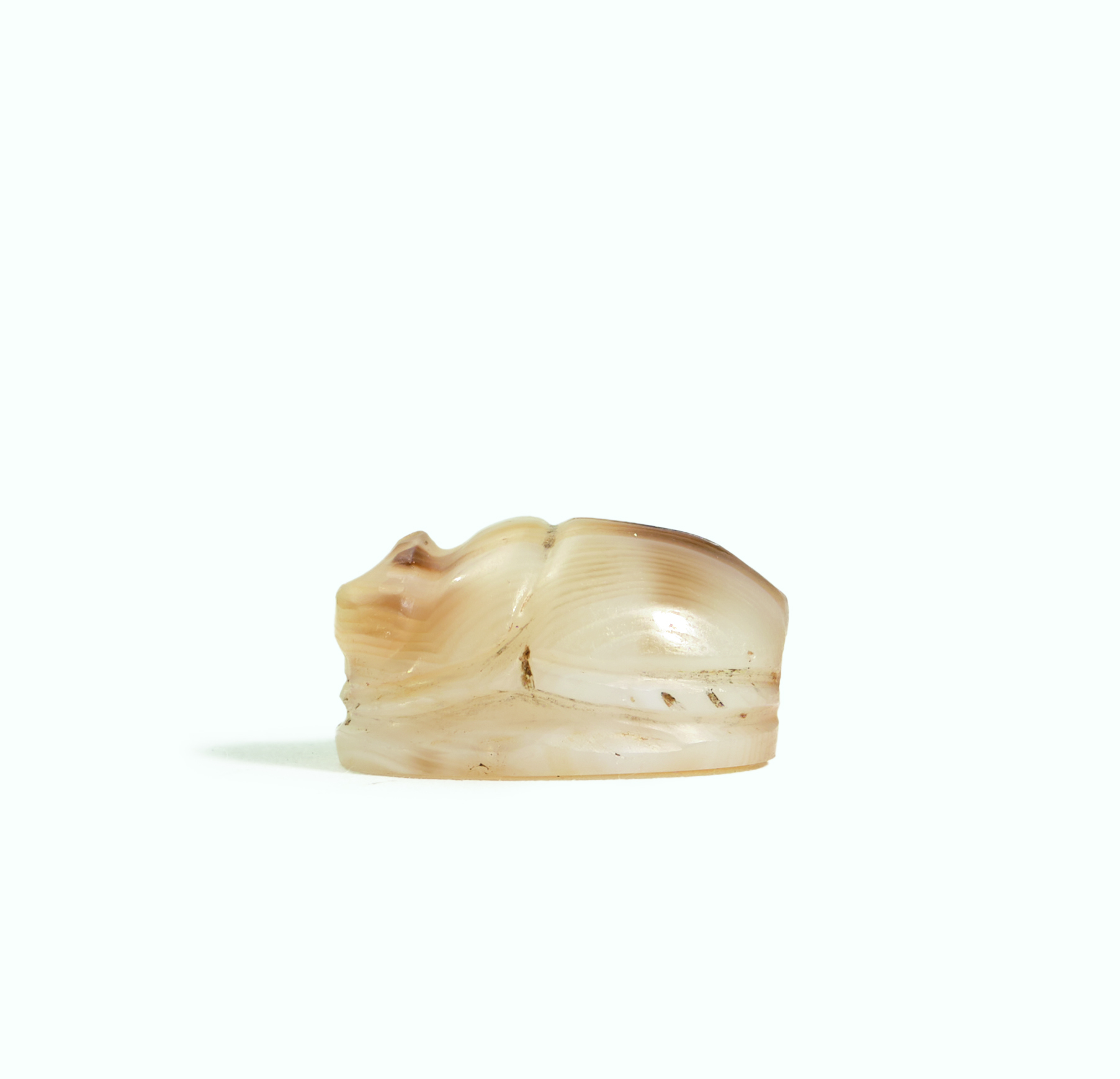
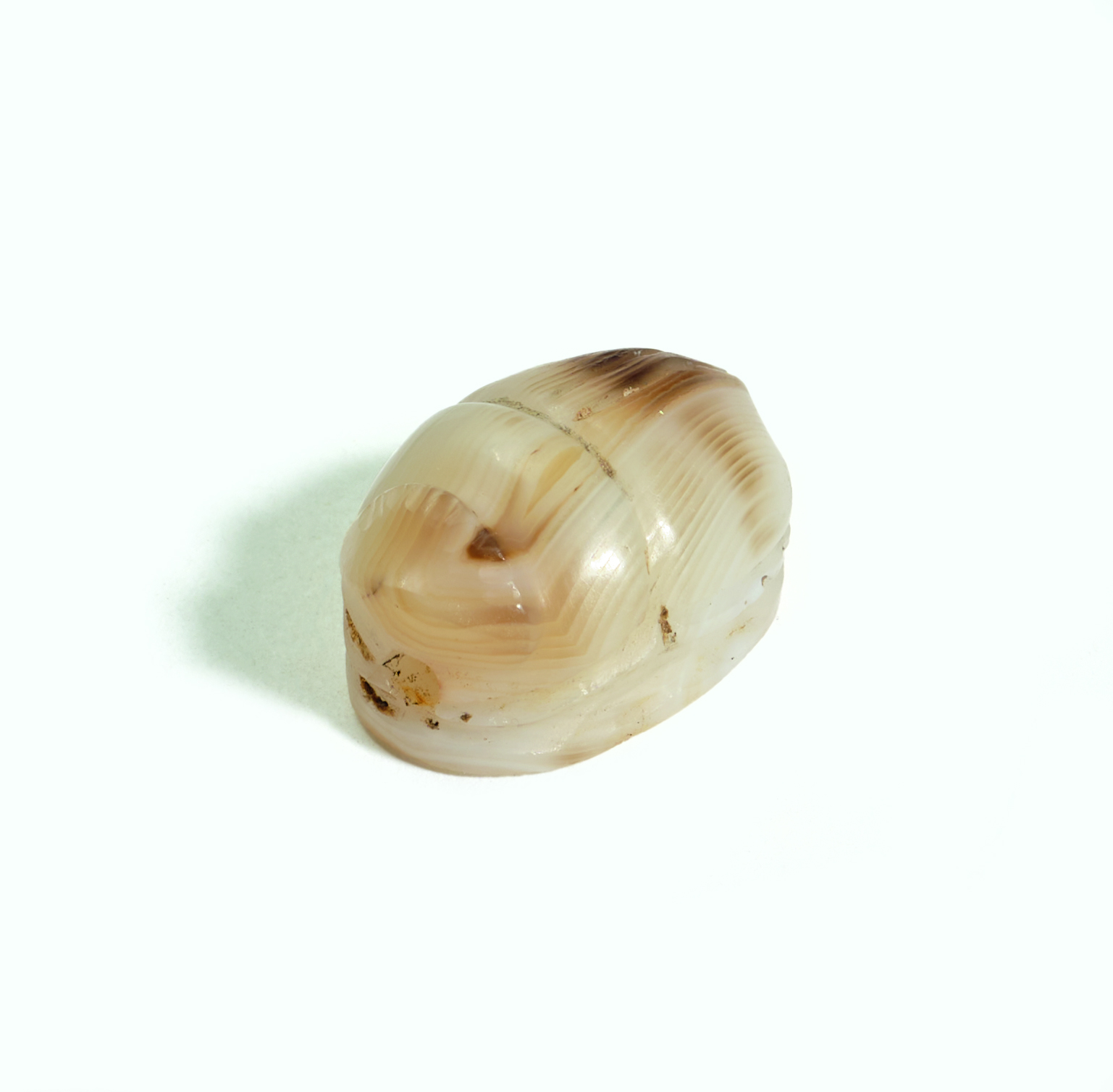
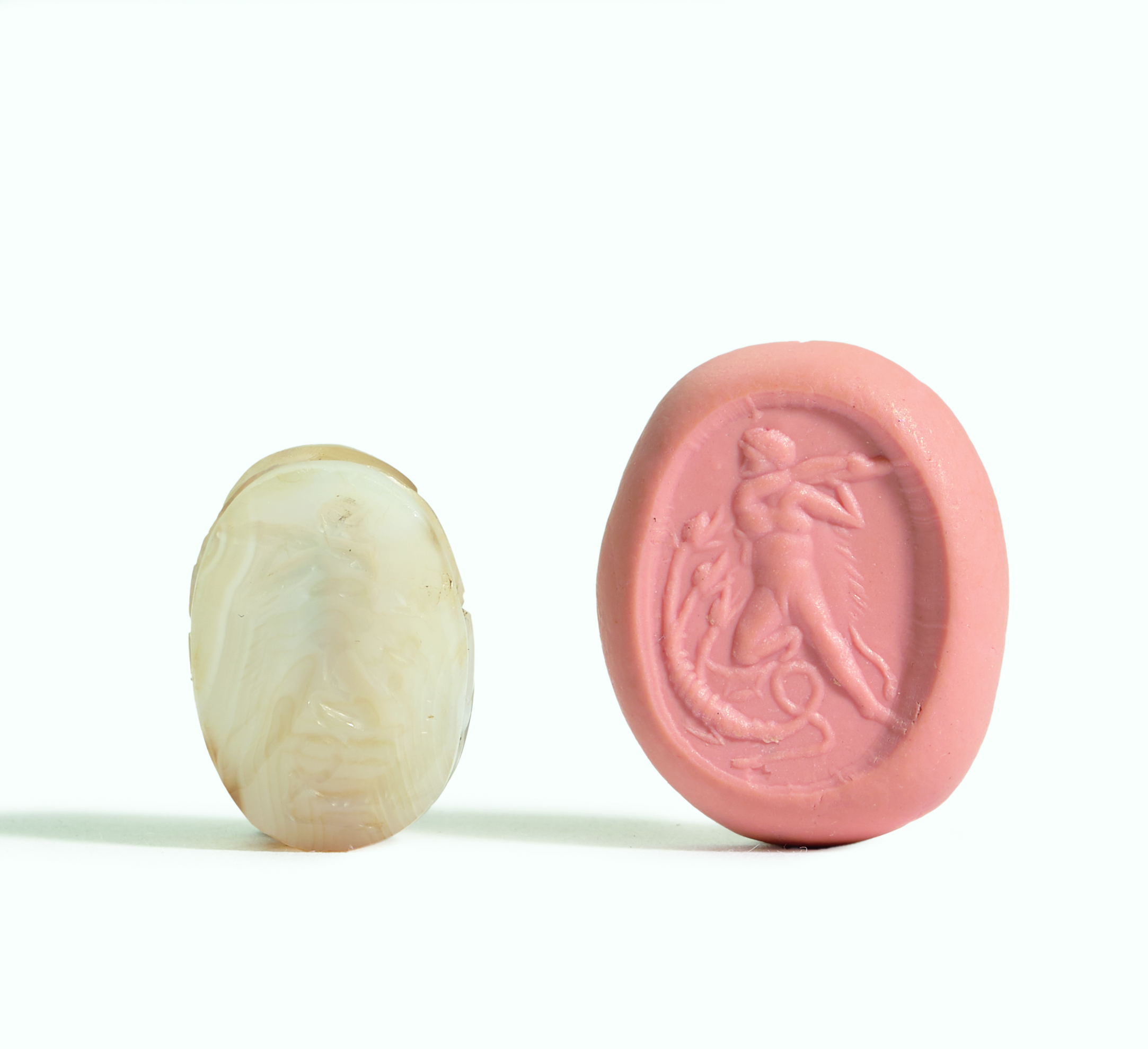
White-Brown Sardonyx Scarab

Period
Greek, archaic period, last quater of 6th century B.C.
Dimension
H. 1.5 cm (0 19⁄32 in) W. 1.17 cm (0 29⁄64 in)

Formerly Georges Asdéry  (*1896 -†1961), Berne
Collection Dr. Rudolf Schmidt (*1900-†1970), acquired on 7 September 1953 from the above, (listed in the inventory with the following note "Wein-brauner Skarabäus mit Herkules gegen Schlange kämpfend"
By descent to his sister Erica Peters-Schmidt (*1899-†1988), Kilchberg, thence by descent

For another Archaic scarab with very similar subject cf. Adolf Furtwängler, Die antiken Gemmen: Geschichte der Steinschneidekunst im Klassischen Altertum, Leipzig und Berlin, 1900, p. 83 pl. 17.4
For gems showing Herakles and the Lernean Hydra cf. Adolf Furtwängler, Die antiken Gemmen: Geschichte der Steinschneidekunst im Klassischen Altertum, Leipzig und Berlin, 1900, p. 36, pl. 7.55; p. 83, pl. 17.4; p. 92, pl. 19.3; 
Peter Zazoff, Etruskische Skarabäen, 1968, 62, 81 pl. 21.81
John Boardman, Greek gems and finger rings. Early bronze age to late classical, London 2001, p. 385 and 397, fig 321

The bezel shows Herakles naked save for his lion skin, engaged in combat with the Lernean Hydra—his second labour. With his left knee bent, he pins the three-headed monster to the ground. In his outstretched right hand, he grips the club with which he is poised to strike the beast down.

Herkles' second labour
Herakles’ second labour, set by King Eurystheus, was to slay the Lernaean Hydra—a fearsome, multi-headed serpent that haunted the marshes near Lake Lerna. Unlike ordinary beasts, the Hydra possessed a terrifying ability: whenever one of its heads was cut off, two new ones would sprout in its place. To make matters worse, the creature had an immortal head that could not be killed by conventional means. As Herakles battled the monster, a giant crab sent by Hera attacked him, but he swiftly crushed it beneath his foot. Realizing he could not defeat the Hydra alone, Herakles enlisted the help of his nephew Iolaus. Together, they devised a strategy: each time Herakles severed a head, Iolaus cauterized the wound with fire, preventing new heads from growing. Finally, Herakles buried the immortal head under a massive rock, ensuring it could never return. Victorious, Herakles dipped his arrows in the Hydra’s poisonous blood, which would later play a fateful role in his mythic journey.

Dr. Rudolf Schmidt
Rudolf Schmidt (*1900-† 1970) and his sister Erica Peters-Schmidt (*1899-† 1988) were born into the well-known Solothurn industrialist and collector family Müller on their mother’s side. Both Schmidt’s uncle, Josef Müller, and his sister, Gertrud Dübi-Müller, amassed impressive collections of paintings, some of which they later bequeathed to the Kunstmuseum Solothurn. From a young age, the siblings developed connections with renowned Swiss artists such as Cuno Amiet, Giovanni Giacometti, Ferdinand Hodler, and Félix Vallotton. Josef Müller was also passionate about non-European tribal art. His extensive collection became part of the Musée Barbier-Mueller in Geneva, which was founded by his daughter Monique and son-in-law Jean-Paul Barbier.
After an educational trip to Iran, Rudolf Schmidt developed a true passion for Luristan bronzes and started collecting Near Eastern art in the early 1930s. From the late 1930s onwards, he enlarged his collection with Egyptian art. With the assistance of dealers like Nicolas Koutoulakis (*1910-†1996), Eli Borowski (*1913-†2003) and others, he built a significant collection of Egyptian stone vessels, with highlights mostly from the Early Dynastic Period. His extensive collections of works of ancient civilizations - including Etruscan, Greek, Roman, African and pre-Columbian art - as well as paintings from the classical Swiss modern period, was unique in Switzerland.
As a patron of the arts, Rudolf Schmidt played a prominent role in the artistic scenes of Zurich and Basel, lending important works of art to exhibitions and bequeathing his considerable collection of bronzes from Luristan to the Rietberg Museum after his death in 1971. His sister-in-law and heiress later donated her brother's extensive collection of over 340 Near Eastern scroll and stamp seals to the Biblical Institute of the University of Fribourg in 1981. This collection of scroll seals is one of the ten most important of its kind in Europe. Other parts of the collection were gifted to the University of Fribourg, the Archaeological Museum in Zurich, Solothurn and Basel. 

You may also like

View More