Red-Figure Nolan Amphora

Period
Greek, Attic, classical period, 440 B.C.
Dimension
H. 22.2 cm (8 47⁄64 in) W. 13.1 cm (5 5⁄32 in)

European private collection
Sotheby's Antiquities, Catalogue of Fine Egyptian, Greek, Roman, Cycladic and South Arabian Antiquities, London, June 16th, 1959, lot 161, from the above
Collection Bier, Germany, from the above
Collection M. B., Hessen, Germany, until 2025

John Davidson Beazley, Attic Red-Figure Vase-Painters, 2nd edition (Oxford, 1963): 1070.5
Bulletin du Musée Hongrois des Beaux-Arts, Budapest: 83 (1995) 29, fig. 26 (UF)
Beazley Archive Pottery Database with the Vase Number 214418

Hoppin, James C. and Albert Eugene Gallatin. 1926. Corpus Vasorum Antiquorum, USA 1, Hoppin and Gallatin Collections. p. 101, Gallatin pl. 55.2a–b, Cambridge, MA: Harvard University Press.


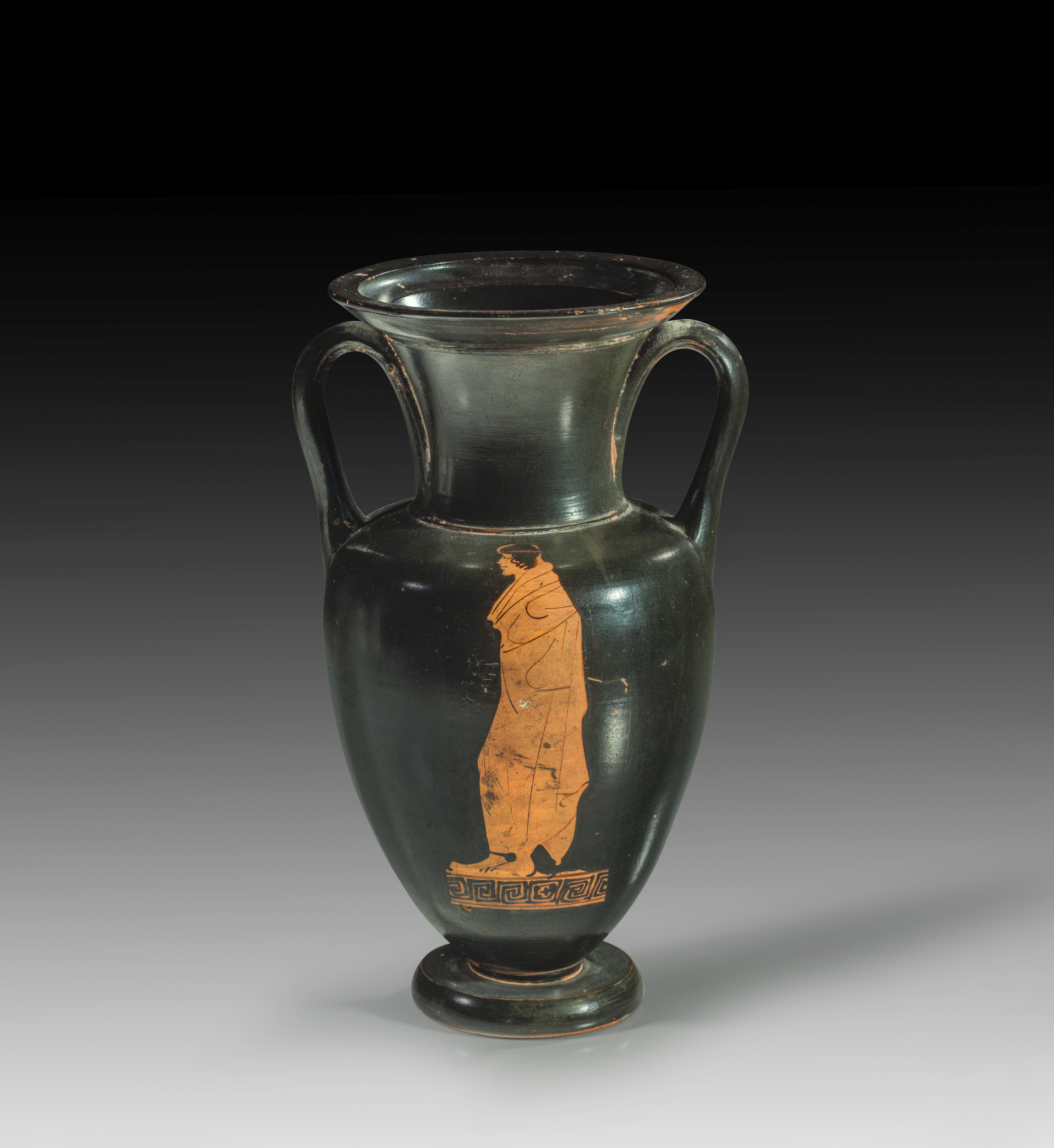
On the obverse, a young woman stands holding a phiale and an oinochoe. The artist renders the latter in a bold, slightly oblique view, accentuated by the stream of wine being poured. She wears her hair neatly bound under a sakkos and is dressed in a chiton and himation. On the reverse, a draped youth is depicted. Both figures stand upon a short meander band. Added red highlights details such as the hair ties and the wine. The amphora itself has an echinus mouth, ridged handles and an echinus foot.

Note
The career of the Richmond Painter, active around 440 B.C., appears to have been closely associated with the Painter of London E 342 and the Painter of the Louvre Symposion. During this period he worked predominantly on Nolan amphorae, though he also decorated a small number of oinochoai. Only a limited number of vases have been securely attributed to his hand.
The vase shape known as a Nolan amphora takes its name from Nola, Italy, where the first examples were discovered. Characterised by an ovoid body, an elongated flaring neck, and a distinctive inverted lip fitted with grooves for a lid, the vessel has handles that rise from the shoulder and reattach at the base of the neck. Amphorae of this type were most likely used for the storage of wine, olives, or oil.

You may also like

View More