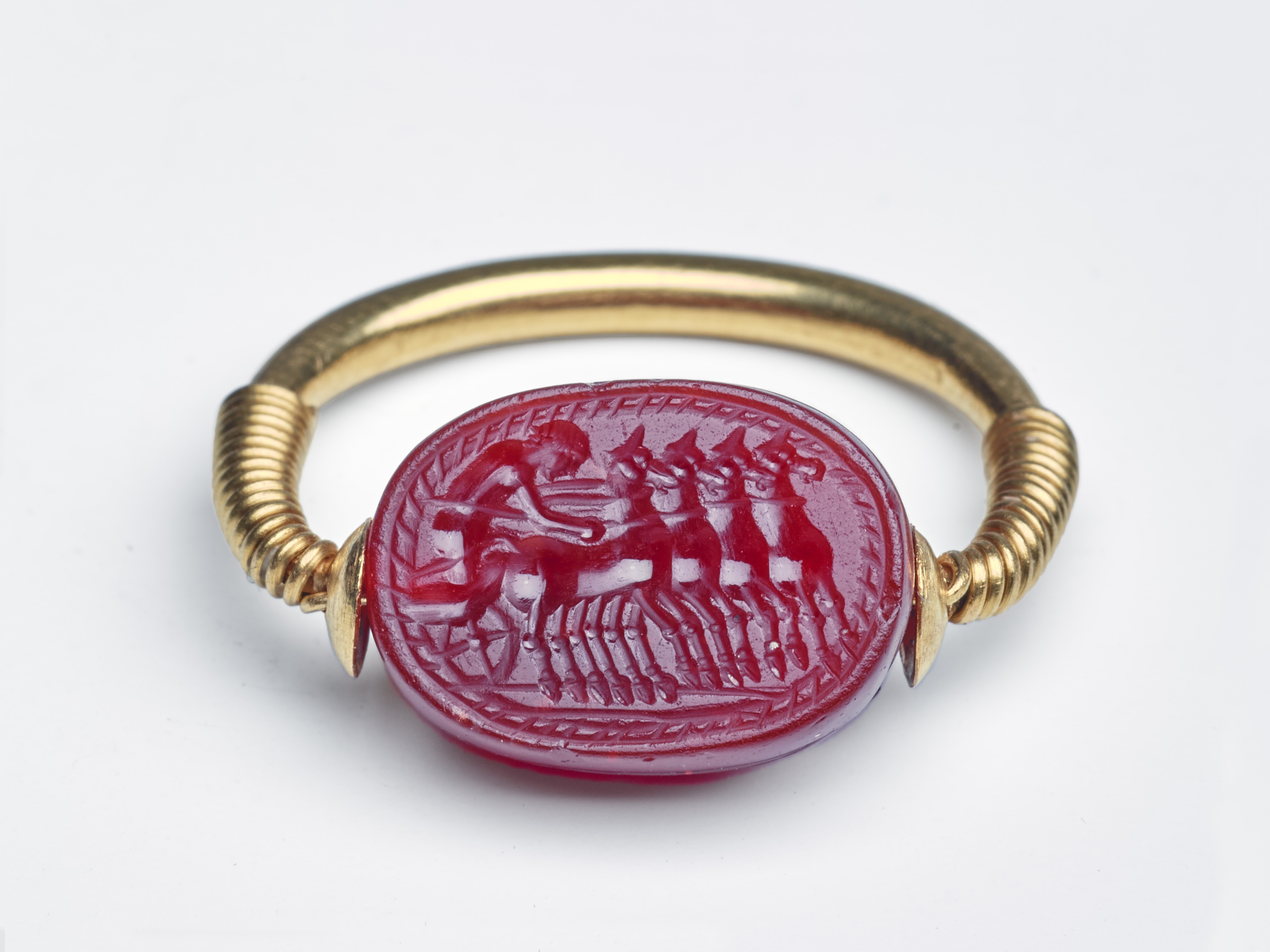
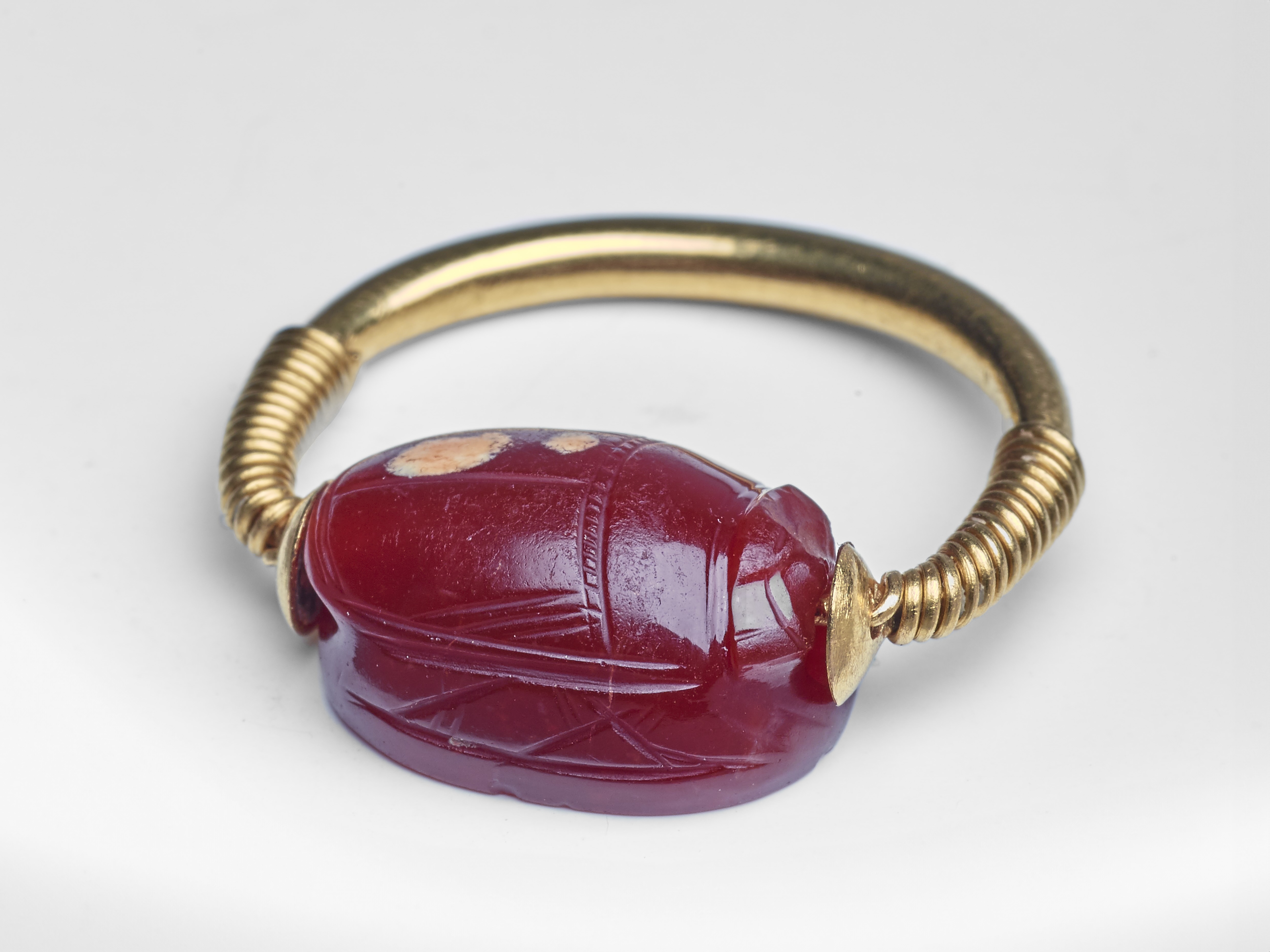
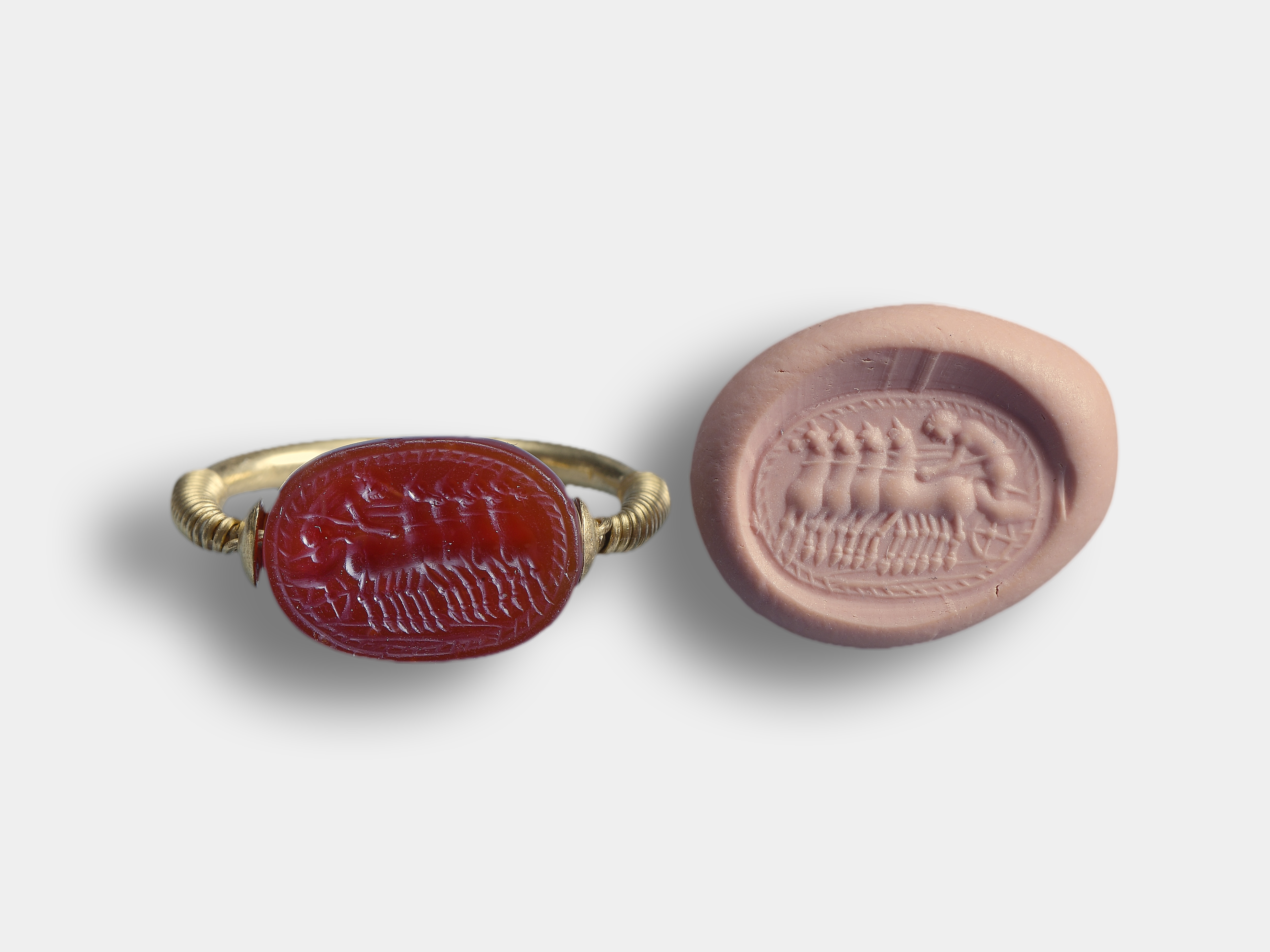
The beetle is well detailed with a hatched border to the thorax, V-shaped winglets and undecorated plinth. The bezel shows a quadriga, in slow movement, with stooping charioteer (l.) enclosed within a hatched border. Horses' heads and legs evenly lined, eight fore-legs and six hindlegs visible, the former all slightly raised and bent. Charioteer (l.) nude, bending forward, left arm outstreched as if to caress the outer horse. The material is a fine sard with slight discolorations on the back; the beetle's wings are shown. Mounted in its original setting.
Dr. Rudolf Schmidt
Rudolf Schmidt (*1900-† 1970) and his sister Erica Peters-Schmidt (*1899-† 1988) were born into the well-known Solothurn industrialist and collector family Müller on their mother’s side. Both Schmidt’s uncle, Josef Müller, and his sister, Gertrud Dübi-Müller, amassed impressive collections of paintings, some of which they later bequeathed to the Kunstmuseum Solothurn. From a young age, the siblings developed connections with renowned Swiss artists such as Cuno Amiet, Giovanni Giacometti, Ferdinand Hodler, and Félix Vallotton. Josef Müller was also passionate about non-European tribal art. His extensive collection became part of the Musée Barbier-Mueller in Geneva, which was founded by his daughter Monique and son-in-law Jean-Paul Barbier.
After an educational trip to Iran, Rudolf Schmidt developed a true passion for Luristan bronzes and started collecting Near Eastern art in the early 1930s. From the late 1930s onwards, he enlarged his collection with Egyptian art. With the assistance of dealers like Nicolas Koutoulakis (*1910-†1996), Eli Borowski (*1913-†2003) and others, he built a significant collection of Egyptian stone vessels, with highlights mostly from the Early Dynastic Period. His extensive collections of works of ancient civilizations - including Etruscan, Greek, Roman, African and pre-Columbian art - as well as paintings from the classical Swiss modern period, was unique in Switzerland.
As a patron of the arts, Rudolf Schmidt played a prominent role in the artistic scenes of Zurich and Basel, lending important works of art to exhibitions and bequeathing his considerable collection of bronzes from Luristan to the Rietberg Museum after his death in 1971. His sister-in-law and heiress later donated her brother's extensive collection of over 340 Near Eastern scroll and stamp seals to the Biblical Institute of the University of Fribourg in 1981. This collection of scroll seals is one of the ten most important of its kind in Europe. Other parts of the collection were gifted to the University of Fribourg, the Archaeological Museum in Zurich, Solothurn and Basel.