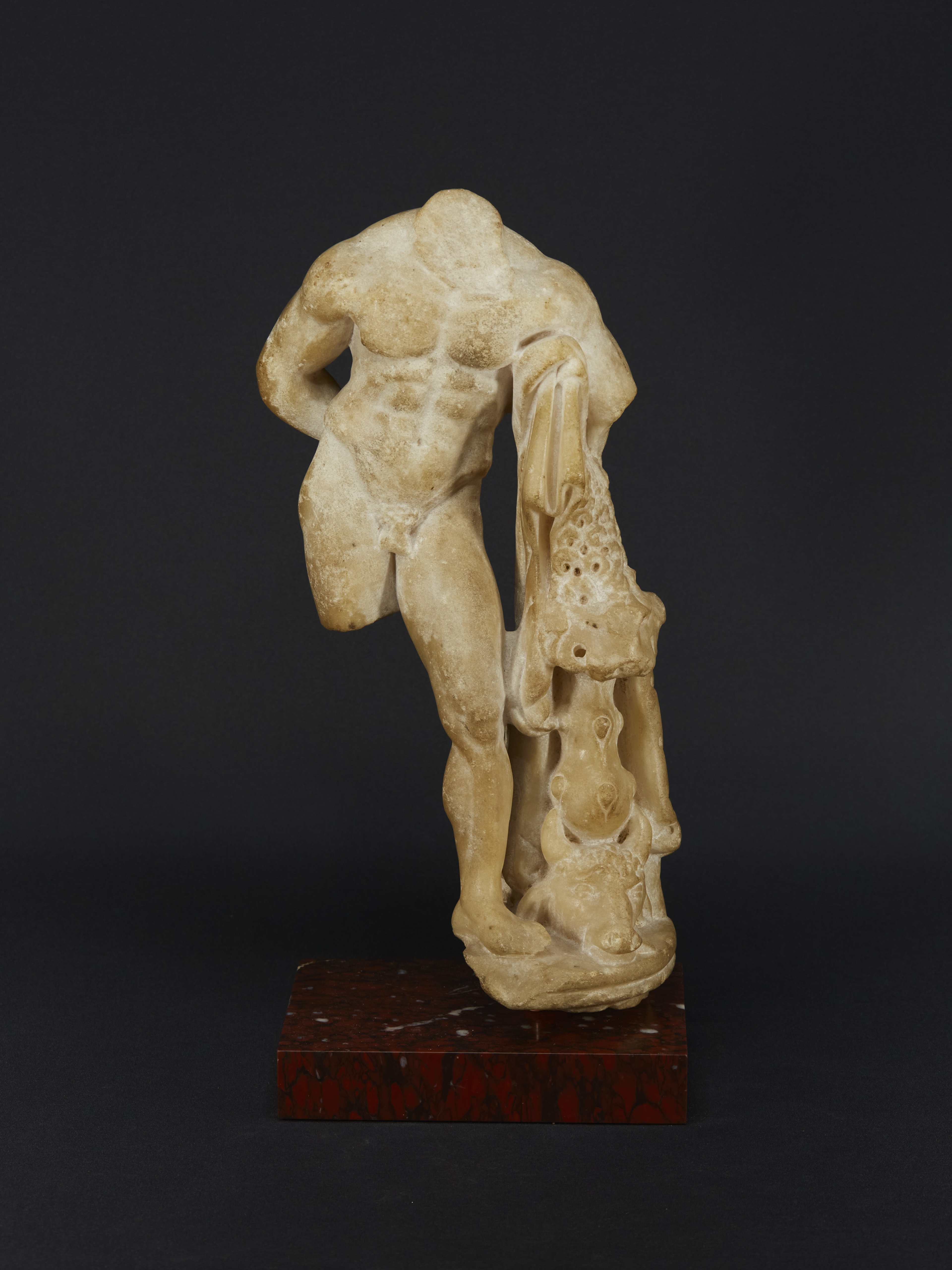
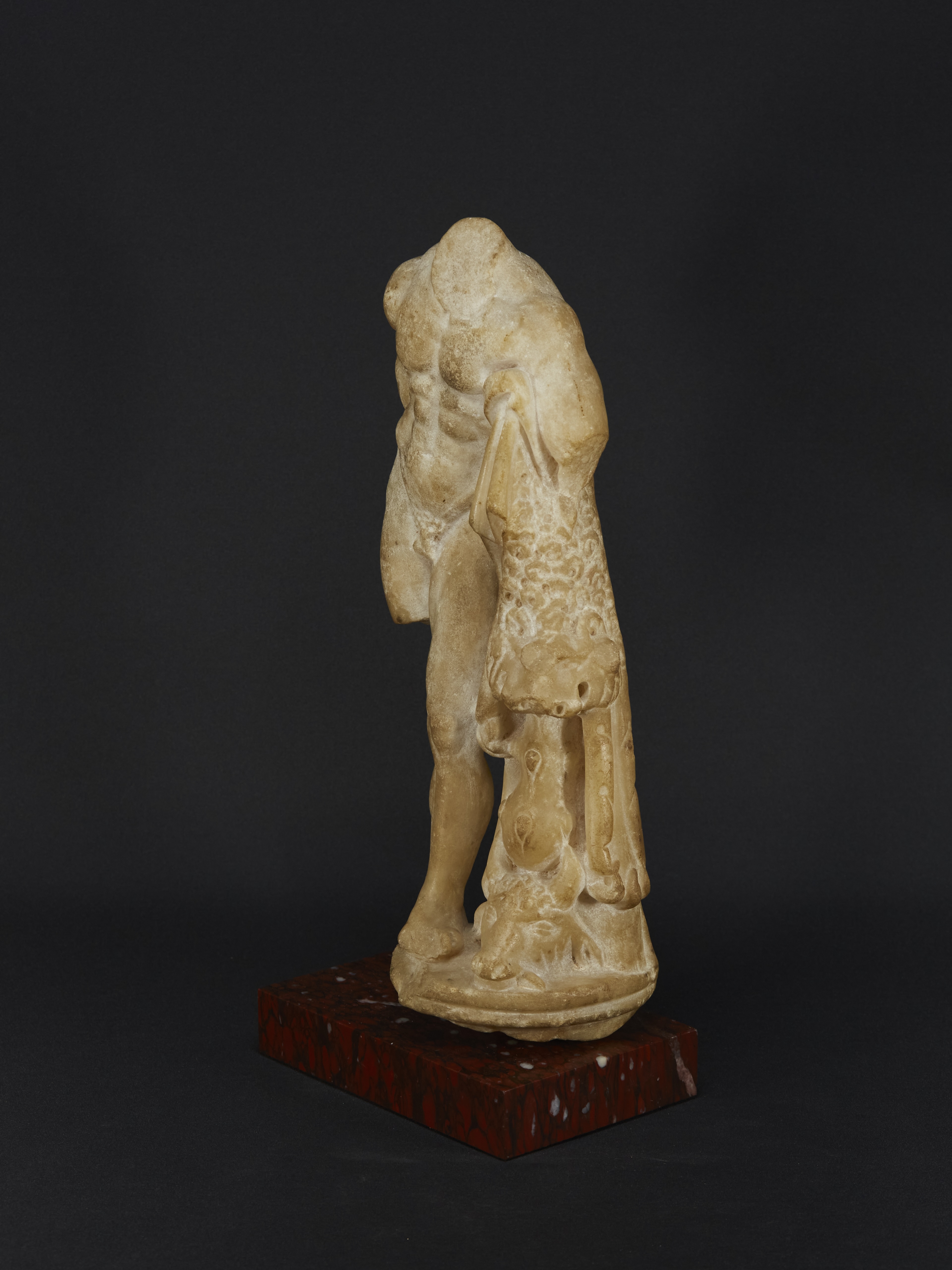
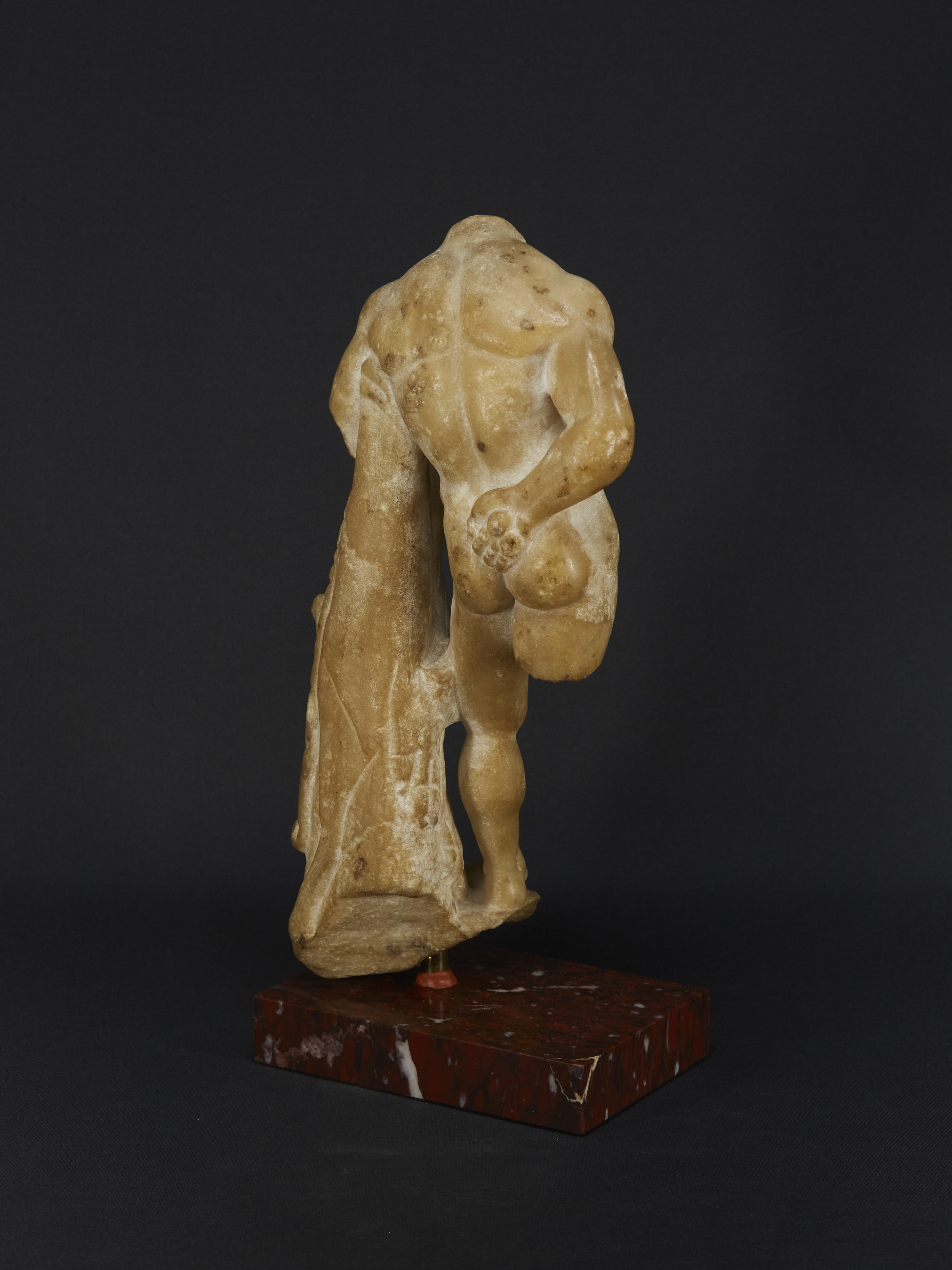
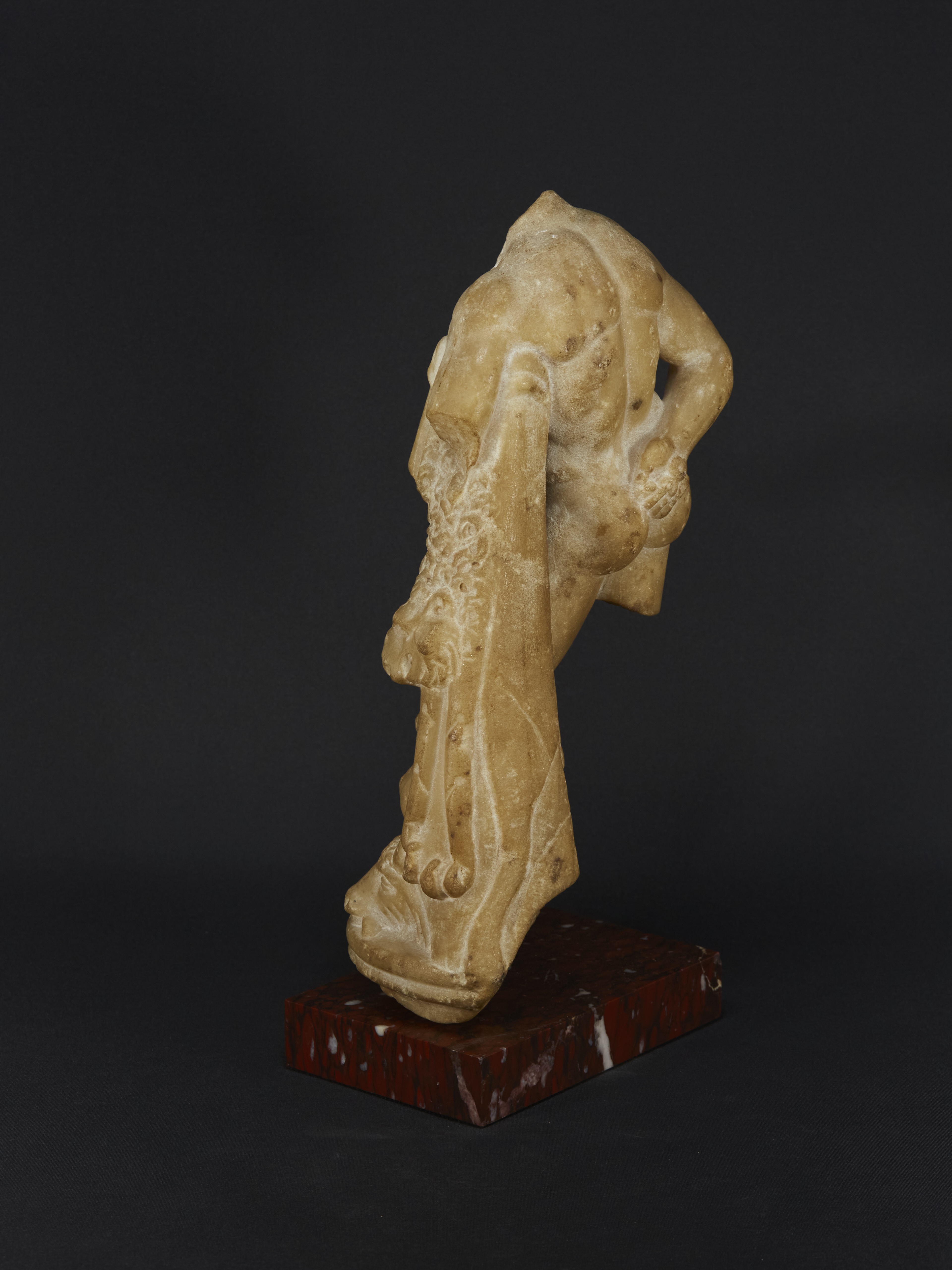
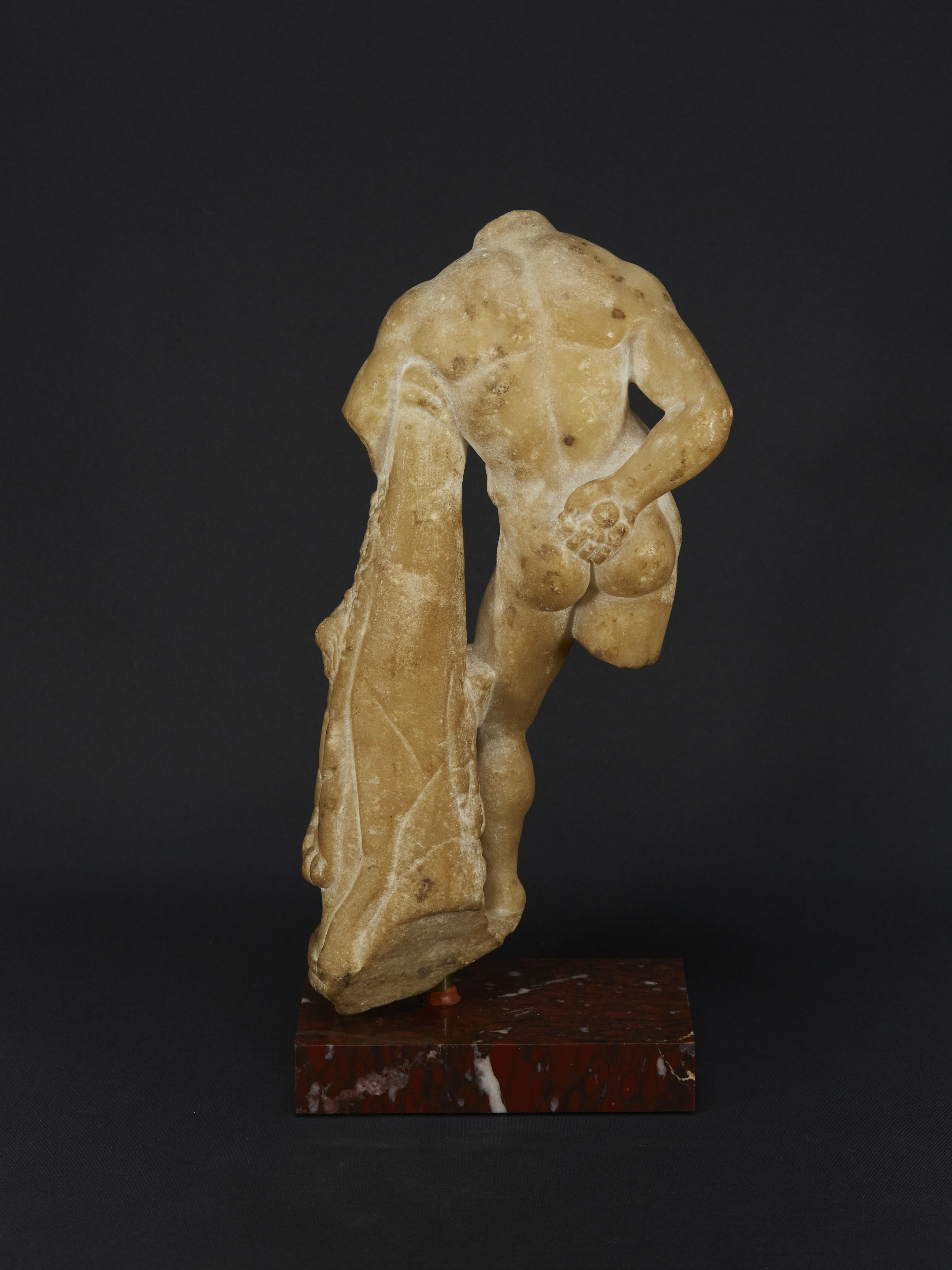
Marble statuette of Herakles resting
The large Roman marble statue of a resting Herakles, in the Caserta type and traditionally known as the “Latin Hercules,” stands prominently on the Grand Staircase of the Royal Palace of Caserta. The work is one of a pair of matching statues originally displayed in the tepidarium of the Baths of Caracalla in Rome. Its counterpart, the so called Herkales Farnese is now housed in the National Archaeological Museum of Naples.
The statue entered the Farnese collection and was later inherited by Charles of Bourbon. In 1807 it was restored and transferred to the Royal Palace of Caserta, where it has remained ever since. Together with its twin in Naples, it represents an important Roman adaptation of the celebrated Herakles type associated with the Farnese sculptures.
Old European private collection from the beginning of the 20th century, based on the yellowed patina
Private collection Mrs Hélène Fabre (*1943-†2019), Paris, France, prior to 1965, thence by descent to her daughter Mrs. N.R. (*1965)
Mounted by Claude de Muzac (*1934-†2022), La Grotte-Galerie, sculpteur-designer & galeriste française contemporaine, prior to 1965
Princesse Claude de Broglie née Claude de Dalmas, dite Claude de Muzac (*1934-†2022)
 Claude de Muzac was a French sculptor and designer whose work focused on innovative systems of framing and display for paintings, works on paper and objects. Trained in drawing at Paul Colin’s studio and initially active as a window dresser, she later worked with the gallerist Daniel Cordier, developing a refined understanding of exhibition presentation.
From the early 1960s she devised experimental solutions using plexiglas, enamel, shell, bone, precious woods, metals and stone, often to reframe or recontextualise rare or damaged works. Her practice encompasses transparent double-glass frames that expose the wall behind, stainless-steel table easels with adjustable height, and protective plexiglas mounts for prints and photographs. Particular emphasis is placed on plinths and bases, produced in plexiglas, rosewood, metal and marbles of various colours, selected in relation to the dimensions and materiality of the object; for flatter pieces she often employs vertical glass plates set into marble or agate bases, creating an almost dematerialised support.
Diethelm Krull, Der Herakles vom Typ Farnese : kopienkritische Untersuchung einer Schöpfung des Lysipp, 1985, 191-237
EAA Suppl. II 2 (1994), 489, s.v. Ercoli Farnese, (P. Moreno), 489-494
Brunilde Sismondo Ridgway, Hellenistic Sculpture I: The Styles of ca. 331–200 BC, 2001
A. Linfert, Die Schule des Polyklet, in: H. Beck-P. Bol-M. Bückling (hrsg.), Polyklet. Der Bildhauer der griechischen Klassik. Ausstellungskatalog Frankfurt a. M., 1990, 240-297
T. Zeyrek - I Özbay, Statuen und Reliefs aus Nikomedeia, IstMitt 56, 2006, 280-287
Nikolaus Himmelmann, Der Ausruhende Herakles, 2009, 123-158
Sascha Kansteiner, Lysipps Statuen des Herakles, in: Archäologischer Anzeiger, 1 • 2020, 121-138
S. Kansteiner, Λuσιπποu εργον / eine Ergänzungsfälschung des 16. Jahrhunderts, in: A. Delivorrias u.a. (Hrsg.) ΣΠΟΝΔΗ. Gedenkschrift für Giorgos Despinis, 2020, 379-386
Sascha Kansteiner, Vielbewundert. Der Herakles Farnese, in: Holger Jacob-Friese (Hrsg), Herkules. Held und Antiheld. Katalog, Staatliche Kunstsammlungen Dresden 2025, 132-143
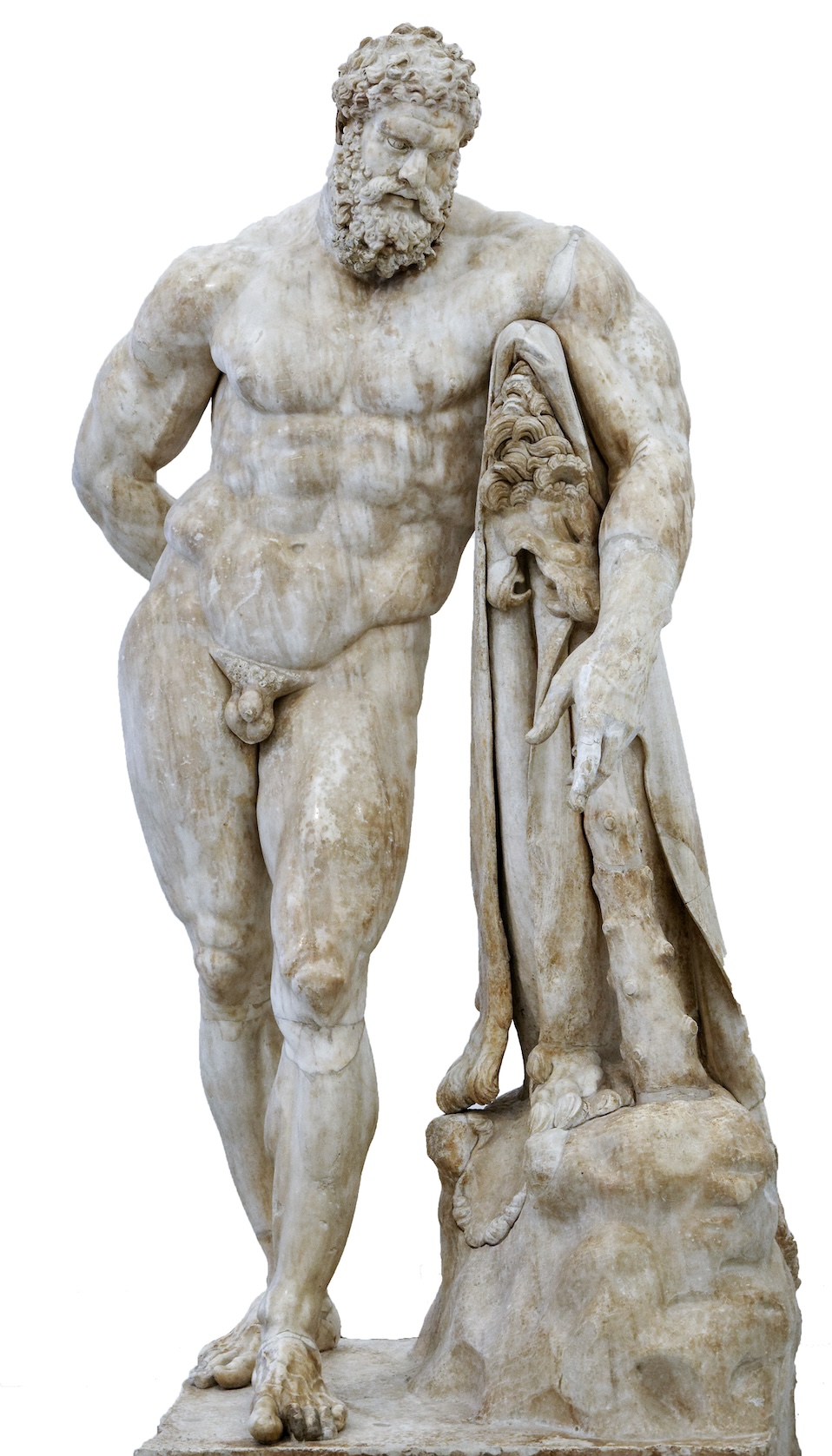
This marble statuette depicts Herakles in heroic nudity, adopting the characteristic resting pose associated with the so-called Herakles Caserta, the lesser-known yet considerably rarer counterpart of the Farnese Herakles.
Derived ultimately from a lost bronze by Lysippos of Sicyon in the late 4th century BC, this independent hellenistic development of the Farnese type captures the hero at a moment of quiet exhaustion after completing his Labours. The figure stands in pronounced contrapposto - while the Farnese type places the free leg slightly forward of the supporting leg, the Caserta variant positions the free foot almost at a right angle beside the supporting foot—a feature reflected in the present work. This dynamic shift produces the distinctive torsion of hips and shoulders—a sculptural pose invented by the Greek sculptor Polykleitos in the 5th century BC to perfectly represent the human body, and used here to communicate both physical strain and monumental dignity.
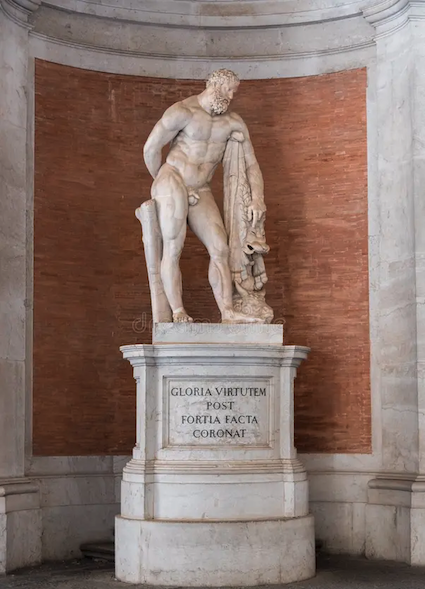
Despite the loss of the head and parts of the limbs, the statuette preserves the essential formal vocabulary of the Caserta type: an emphatically modelled torso, a forward-thrusting abdomen, and the characteristic gesture of the right arm drawn behind the back, in which—by analogy with canonical examples—the hero holds the apples of the Hesperides, the emblem of his penultimate Labour.
At the hero’s right side hangs the Nemean lion skin, its textured pelt carved with notable care as it cascades down a support. In a distinctive departure from the standard iconography—but in keeping with the Herakles Caserta type—the support takes the form of the Cretan bull’s head, upon which Herakles’ club rests firmly. This unusual element introduces a note of narrative individuality to this Roman Imperial–period composition, replacing the simple pillar, rock, or tree trunk more commonly associated with versions of the Farnese model. The finely carved bull’s head, positioned beneath the lion skin and the club, creates a compact yet expressive visual support that securely anchors the figure within the surrounding space.
The muscular modelling of the torso, back, and flanks, together with the warm hue of the marble and the ancient wear across the surface, lends the piece a sculptural gravitas that belies its modest scale. Although fragmentary, the statuette demonstrates the enduring appeal of the Herakles Caserta in small domestic formats, and contributes to our understanding of how heroic Greek prototypes were diffused, adapted, and reinterpreted for private contexts. 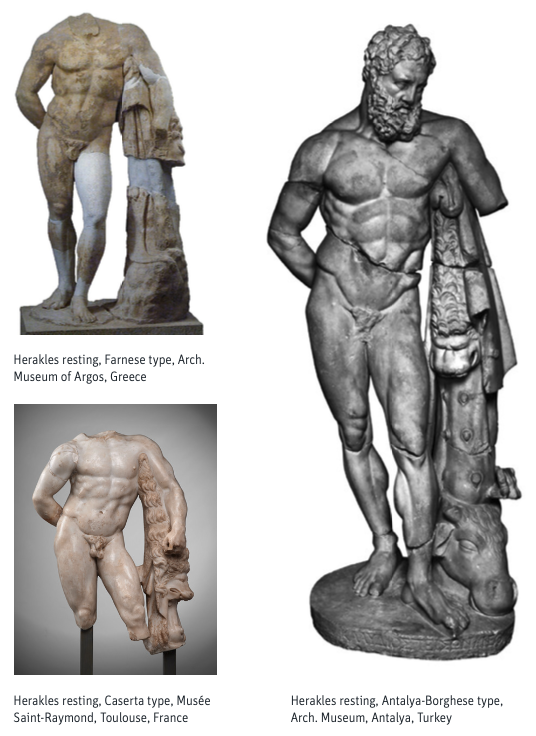 The Herakles Resting type is a much-admired representation from Antiquity, symbolising the hero’s moment of rest after arduous feats, holding the apples behind his back and leaning on his club draped with the Nemean lion’s skin. It offers a visual summary of Hercules’s mythic journey—from slaying the invulnerable Nemean lion to retrieving the guarded apples—and shows the hero’s body placed purposefully in three-dimensional space, inviting viewers to circle the statue to fully appreciate its narrative depth.
The figure is mounted on a later plinth of mottled red marble, an early modern addition characteristic of the post-Renaissance practice of recontextualising ancient fragments for aristocratic and scholarly collections. This intervention forms part of the object’s documented reception history and attests to the long-standing esteem in which the Heraklean type has been held from antiquity to the present.